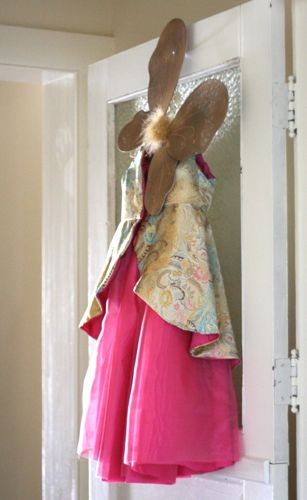
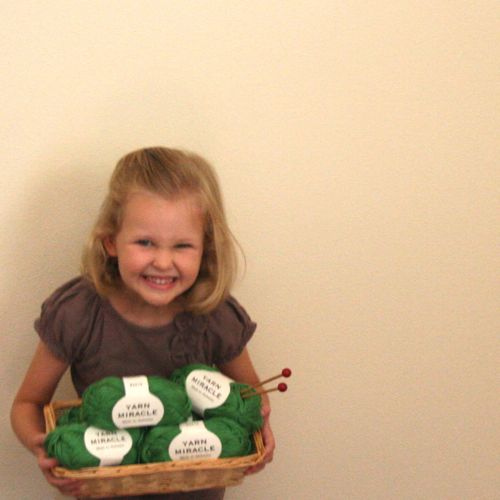
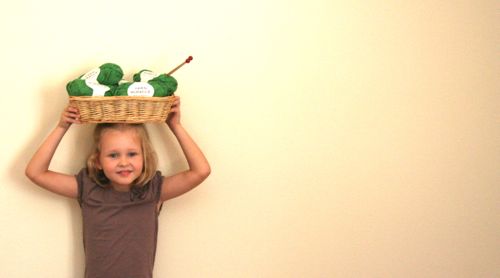
First, Ellie’s Halloween costume is finished! (except for the hook on the jacket – I’ll do it when Lady Bird gets out of my lap)
Not pictured: Crown and wand.
Second, I haven’t had a Butterfinger in three years but I don’t miss them anymore because oh my oh my oh these are SO GOOD. You’ll need a candy thermometer, and don’t tweet that you are making candy while the sugar is on the heat.
Ingredients
1 c. creamy peanut butter (not the natural kind)
1 tsp. vanilla extract
¼ tsp. salt
1 c. sugar
â…“ c. light corn syrup
½ c. water
¾ c. chocolate chips (Ghiredelli semi-sweet are dairy free)
1 T. shortening
Instructions
Grease an 8-inch square pan.
In a small saucepan, stir together peanut butter, vanilla, and salt. Warm all that over low heat until it’s melty and then keep it warm.
In a medium saucepan, stir together sugar, corn syrup and water.
Cook sugar goo over medium-high heat just until it reaches 290 degrees, under hard crack. Don’t tweet. Don’t get bored. Don’t look away it will surprise you!
Quickly stir in peanut butter until well mixed.
Dump in prepared pan, QUICK IT’S ALREADY COOLING!
Let cool on a wire rack (or cold stove eye) for about 8 minutes. Don’t try to eat it yet (HOT).
Melt the chocolate chips and shortening in the microwave. Heat for 30 seconds at a time, stirring in between until molten chocolate is achieved.
Pour the chocolate over the top of the peanut butter candy part and spread it out to coat. Put it in the ‘fridge so it will set more quickly. Cut it into bars and eat every last crumb before you think about taking a picture. Wonder how soon is too soon to make more…
Third thing: I’m sure you noticed that New York City had a LOT of water in it yesterday. New Jersey isn’t much better and there is a lot of surrounding area with storm trouble. I’m sure you’ve already donated to the Red Cross and the Humane Society or other disaster relief organizations if you feel so inclined. But you know, there are a lot of fiber farms up that way who are going to need a little help getting trees off of their fences and patching roofs and the like. So, maybe take a minute to consider doing what knitters do best: find those farms and buy some yarn. Tell them no rush shipping, you can wait. But they’ll know you’re thinking about them.
**THIS GIVEAWAY IS CLOSED. COME BACK LATER IN NOVEMBER FOR MORE MINDFUL FIBER!**
Alpacas are amazing! I didn’t realize just how much I didn’t know about them until I started doing research for this month’s Mindful Fiber! I was going to compare alpaca husbandry in the Americas, but let’s have a lesson about the animals instead.
Things I knew about alpacas before I started doing the research for this article:
They ‘pronk’ when they are happy. I’m not kidding, here’s a baby:
(Pronking is a little bouncy happy dance.)
Things I know about alpacas now:
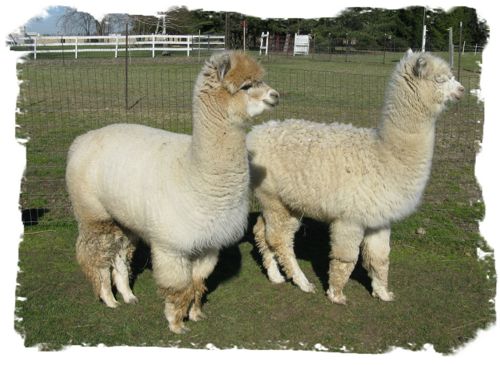
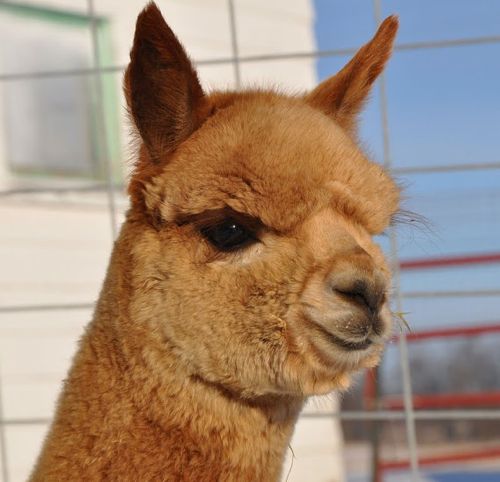
There are two types of alpacas: Suri (long, silky locks of hair) and Huacaya (crinkly, dense fuzz). About 90% of the world’s population are Huacaya. Both have coarse hairs (‘guard’ hairs) that have to be removed before spinning the soft wooly fiber. There’s a machine for that, although my source (see below) says in many cases the guard hairs can be separated by hand.
Alpacas have been domesticated since 4,000BC, so there is no such thing as a ‘wild’ alpaca. Their closest wild cousins are vicuñas.
Alpacas are social animals. They prefer to live in family groups consisting of an alpha male, females and their young. Alpacas make a ton of sounds to communicate: humms, grunts, clicks and a Fearsome squeaky, gaspy, donkey-like noise when threatened.
Gold star if you can tell me Suri or Huacaya!
They are tidy critters who specify a latrine area that the entire group uses.
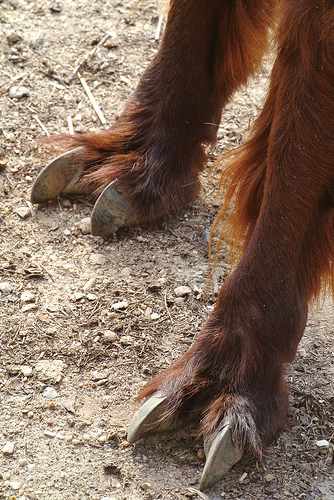
They have paddy feet and toes with toenails – not hooves (neither do camels and llamas so that’s something I should have known). And can spit (that is, vomit grass in projectile fashion) like all camelids. AND only have teeth on the bottom! Food chewing is done by grinding the bottom teeth on an upper plate (hence the sort of figure-8 mouth movement).
Alpacas do not make lanolin! So even if you’ve got a wool sensitivity, alpaca fiber is still worth a try. There is plenty to try: there are 22 naturally occurring colors of alpaca fleece.
The vast majority of commercially available alpaca fiber is still grown in South America – nearly all (like 99%) of the world’s alpaca population is found in the highlands of Peru, Chile and Bolivia. The species was domesticated in the Andes mountains thousands of years ago, and export to other countries has been tightly controlled. It wasn’t until the mid-1980s that the alpaca moved to the U.S. as an industry. And when I say industry, it’s not the fiber that U.S. investors are interested in – it’s the animals themselves! Since the import of alpacas is still limited, an average breeding female can sell for anywhere between $1000 and $30,000. In the U.S., the alpaca industry remains relatively small with few reports of the abuses often seen in the wool industry. But (as with anything) as it grows there will be more potential for neglect and misconduct.
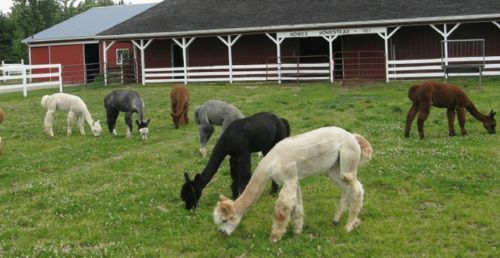
Which is why I gravitate towards small farms for my fiber wants. Small farms with respect for their animals. Small farms like North Star Alpacas.
Maple’s goal is to never have to mow the grass. There’s been a lot of clever fence building with that in mind.
Maple is the self-declared #1 pooper scooper in the North Star barn. She also washes, dyes, picks, cards, and spins the fleece her alpacas grow. The farm is strictly a fiber-farm these days and hosts a herd of 22 alpaca, 2 horses, 2 dogs, 2 barn cats, and 1 house cat. There are four new boys arriving this weekend to bring the herd size up to 26! The North Star Alpacas blog is closed, but I had a wonderful time exploring the archives and learning about life among the hairy. In her own words, “I’m lucky to be doing something that I love that actually pays for itself.”
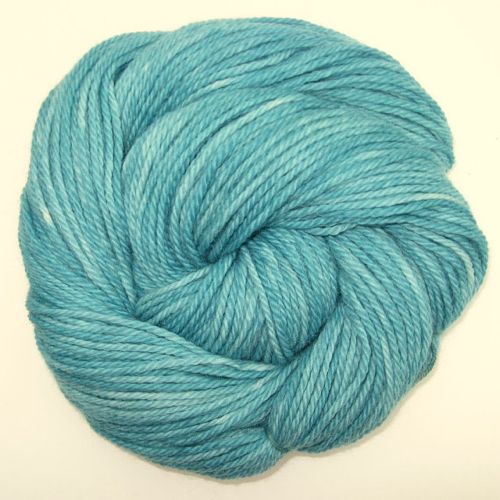
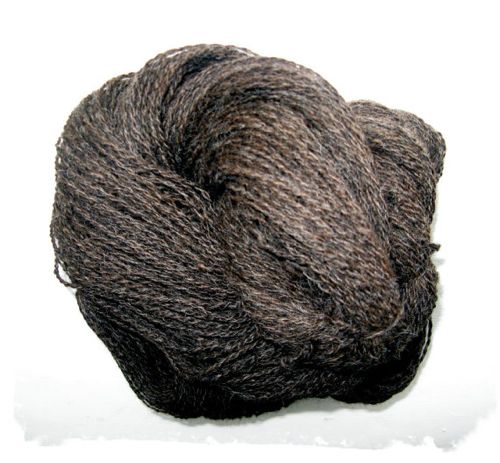
For the month of October, I have a $50 gift certificate to North Star Alpacas’ Etsy shop. You can use it to buy all of this:
If you don’t knit (or if you are feeling lazy), Maple has hats and scarves already made! Shop for Christmas presents for friends (or presents for yourself).
**THIS GIVEAWAY IS CLOSED. COME BACK LATER IN NOVEMBER FOR MORE MINDFUL FIBER!**
Since we’re almost out of October, this is a short short giveaway and will close on Wednesday, October 31, 2012. Don’t waste time – leave a comment on this post to be entered in the drawing. The random number generator will take care of the rest. Since it is a short short short giveaway, I’ll offer extra entries if you promote this on your social media outlet of choice (Ravelry, Twitter, Facebook, etc.)! Please leave a second comment with a link to the post/tweet/whathaveyou for accounting purposes.
You can find North Star Alpacas on Facebook, in PhatFiber boxes, and (of course) on Etsy.
Unless otherwise noted, Maple Smith holds the copyright to all the still pictures used in this article. They are used with permission
**THIS GIVEAWAY IS CLOSED. COME BACK LATER IN NOVEMBER FOR MORE MINDFUL FIBER!**
You know how sometimes you have one of those days where everything just sort of gets away from you and you can’t seem to get anything done because you’re distracted or there always seems to be something not on your To Do list that needs doing?
I’ve had a couple weeks like that.
Our yarn for October’s Mindful fiber won’t arrive in time for pictures (it’s custom). I’m trying to decide if I’m going ahead with that one or scrambling to find something else. I’ll let you know next week!
Unrelated to why I can’t get anything done: Anybody been waiting to play Glitch? I’ve got some invitations.
Wild breeds of sheep naturally shed their wool when the weather warms. There are still a few ‘primative’ North American breeds that have more hair than wool (like dogs and their undercoats), and ‘heirloom’ breeds like Shetlands shed their wool due to a natural break in fiber growth in the spring. However, most breeds were domesticated long, long ago. Commodity and continuous growth won out over sheepy independence and ‘commercial’ sheep breeds require some form of human involvement to loose that wool.
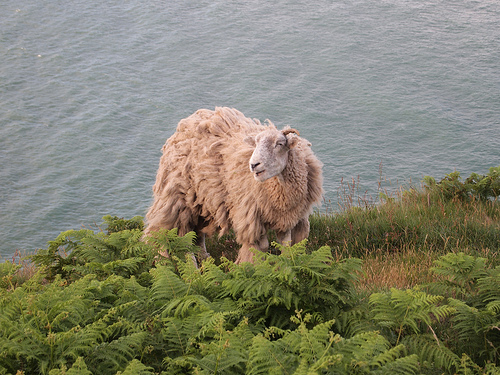
This guy (photographed by McBadger) has evaded the shearers. One New Zealand ram managed to dodge shearing for 6 years – his fleece weighed 60 pounds when he was finally caught.
Farm Sanctuary, a domestic farm animal rescue organization in California, has an excellent article about the necessities of sheep shearing. For today, we’ll focus on the process.
So how does it happen? How does one separate the wool from the wool bearer? Well, it takes some kind of clippers. And a lot of strength. In this video from Plumpton College, the basic method of shearing a sheep is demonstrated.
Certainly looks uncomfortable for the sheep, but he’s keeping her still and stretching her skin to prevent cuts.
Large wool operations have specialized sheds and hire a team of professionals and their electric clippers at shearing time. Machine shears were developed in the 1880s and were in widespread use by the 1940s. A flock can be shorn in a few days to a week or so depending on the number of animals. Many professional shearing groups take pride in how quickly they can work their way through a flock. There are competitions, awards and prestige associated with speed. While this may be good for the workers (who are paid by the critter), it isn’t necessarily good for the sheep.
When numbers or farming practices don’t call for machine shearing (or folks are feeling traditional), blade shearing is used.
She also talks about the ‘whys’ of the process.
There are obvious advantages to blade shearing, particularly in colder climates. The inch or so of wool left behind protects of sheep from cold and sunburn, reduces stress on sheep, reduces how much they need to eat after shearing, and results in heavier birth weight of lambs.
Sheep are typically shorn in spring, preferably before lambing (there is more room in the barn and it’s easier for the lambs to nurse without all that wool). Because of demand and the high price of wool, some flocks are shorn twice a year. An estimated one million sheep die of exposure each year because of practices like this.
Morehouse Farm in New York shears their Merino sheep once a year. Merino sheep are a special case for shearers. One of the oldest breeds of sheep with some of the softest fiber, Merinos are also covered in wrinkly folds of skin. Because of the folds, going at them with clippers is a scary business. It takes two or three days to shear the entire Morehouse flock. The resulting fleece is also processed, spun and dyed in the US. From Morehouse Farm’s FAQ:
Are your Merino sheep happy sheep?
Our sheep are well cared for and we treat them with kindness.
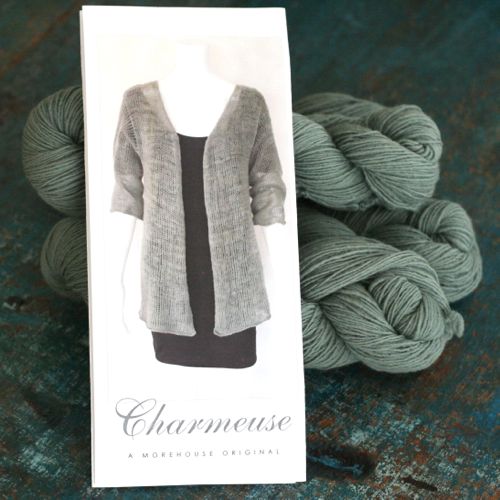
For the September giveaway, I’ve got a whole cardigan!
Charmeuse!
It seems to be the perfect weight for a seasonal transition sweater and probably goes with anything. There is enough yarn there to make the largest size and after perusal of the pattern, it seems like a nice relaxing project. For a chance to win this kit, just leave a comment on this post!
If you hate the color (I was going for elegant and neutral), I’ll include the receipt so you can request an exchange. There’s a really pretty pink…if you like pink.
You can find Morehouse Farm on Facebook, Twitter, and their website (which is where you order the yarn and fleece).
Best of luck – the giveaway will close September 30th so comment early (but in this case, not often)!
I’ll point out that all the sheep in these videos and pictures have their tails docked. The link claims that this is necessary for the health of the sheep. Many animal welfare organizations disagree.
As a curiosity: In 1994, Australian scientists invented a way of removing the wool from sheep without shearing. They inject the sheep with a protein that causes a break in the wool growth, then wrap them in a jackety net. A few weeks later, the fleece peels right off. I also read somewhere that Australian scientists have developed a robot for shearing sheep.
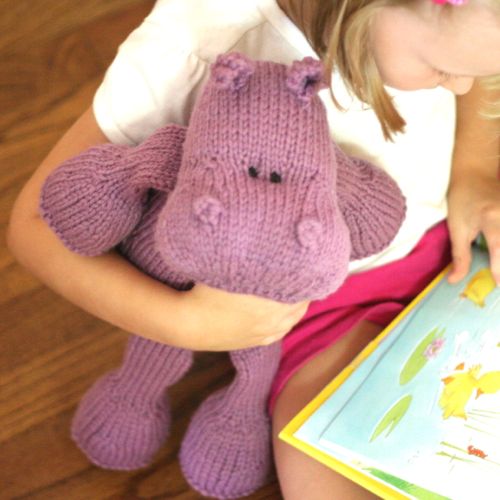
I finished the example hippo in time for Judi’s birthday (back in August). She’s pretty awesome and she loves Hippopotamuses, so I made her a pattern. But since she doesn’t knit, I sent her the example Hippo instead. He’s made with bulky merino from Morehouse Farm – an excellent tie-in to our Mindful Fiber this month. <--Spoiler!
The pattern is available on Ravelry and Etsy*.
Happy Birthday, Judi! You make my life grand.
*What are y’all’s views about having the patterns in the same Etsy shop with the toys? Is that weird to you? Should I make a separate pattern shop now that I’ve got a bunch of them?
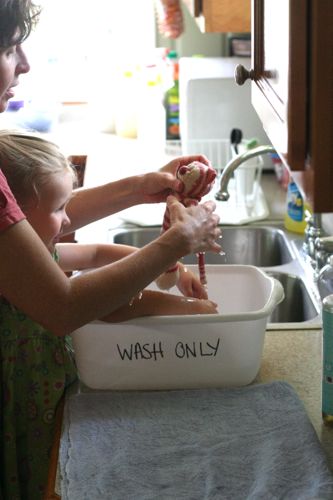
I worked out a little tutorial to show my customers how to hand wash a stuffed animal. If you’ve got a minute, would you take a look at it and tell me if there is anything I left out or that should be added?
My Hiatus Dish Rag has been in in the sink this week, and I’m a little surprised at how much I like the 2nd Time Cotton. It really keeps it’s shape even after being scrubbed around. I think it would be great for a gift cloth since it won’t look chewed on after use. I hope our August winners enjoy their recycled cotton as much as I have!
Ellie has selected winners this month: “Number three and that last one you said.” Big congratulations to Stephanie and KT! I’ve emailed you for addresses and (if you’re very lucky, just ask last month’s winners) I’ll get your yarn in the mail this weekend.
Rainy Day Update: There’s been more rain and wind yesterday afternoon and last night than the rest of the time. Before that there was a couple inches of rain in the gauge (I haven’t been out to check this morning). Thanks for all the good, dry thoughts!
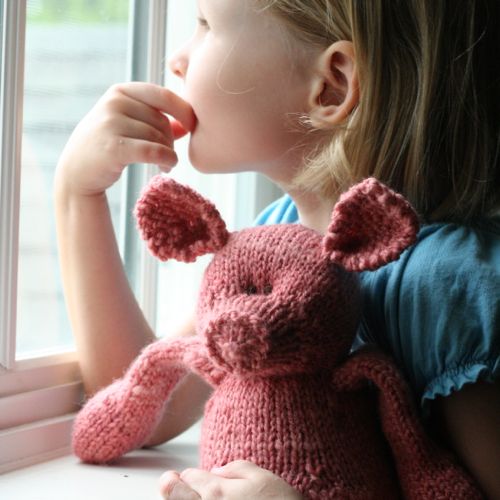
P is for Pig is up on Etsy and on Ravelry. Early adopters should buy on Ravelry, of course. As far as construction, this is pretty typical of the Alphabet Animals so if you’ve made any of my other creatures, you’ll have no trouble.
The recommended yarn for this guy is unique: Cassie at Farm Genevieve has created the the perfect yarn for this little piggy! Not only is it hand dyed and then spun into a great bouncy yarn, but the wool selected comes from a small flock of Jacob sheep, a critically endangered breed. This particular flock is a carrier for Tay Sachs disease (a genetic anomaly fatal to both humans and sheep at a very early age) and is working with scientists find a vaccine to help save both human and sheepy lives. You can find out more about Tay Sachs and Jacob sheep with a little Googling.
For those of you following along: Isaac is still a tropical storm so we are expecting persistent (but not crazy) wind and rain. We are in the extreme East of the hurricane warning and an hour north of the coast. Update: 10:21am No more hurricane warning, we’re downgraded to a tropical storm warning.