Like Chips

I’ve been working on a little something. Several little somethings.

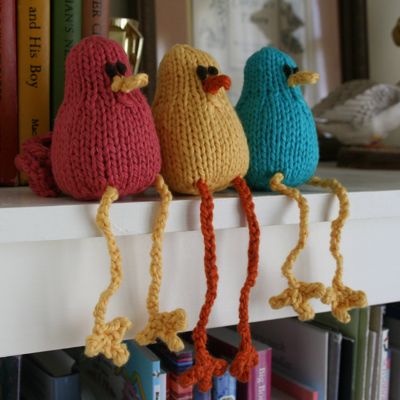
ittybittybirdiefaces

Itty Bitty Birdies

I really wanted a toy that I could produce more quickly and price a little lower. Something fun – silly even – that has a lot of possible variations and maybe a little collectibility. Something where you can’t knit just one.

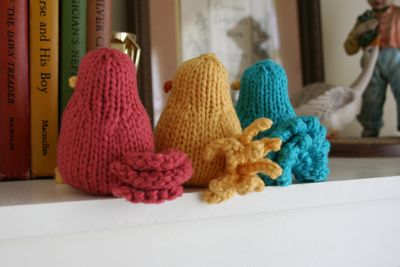
ittybittybirdiebottoms

There are more tail feathers planned!

Pattern Pending. Until then, there are a few Itty Bitty Birdies in the shop.

Oh hey, don’t worry – the pattern will have an i-cord variation for the legs (which are crocheted in the pictures). It bugs me when knitting patterns aren’t just knitting patterns.

I really thought my next pattern would be an alligator. Judi sent me some bumpy, green hand-dyed yarn for my birthday that wants to be an AL-GAH-YAYA (what Ellie calls them, she’s a big fan of alligators). Shows what I know.

Custom Order

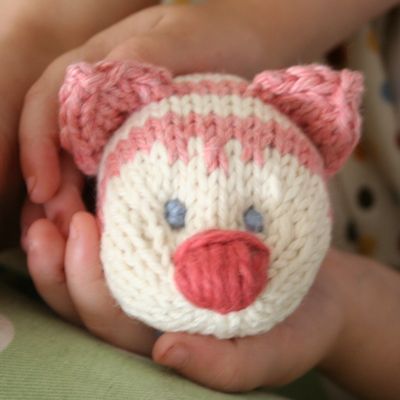
Ellie’s first sentence: Mama knit pink meow?

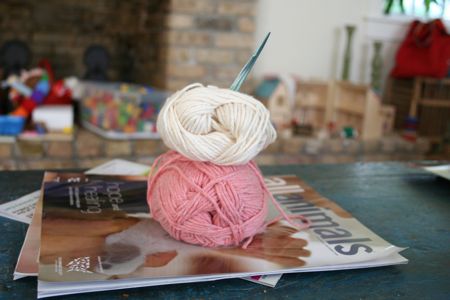
We picked out yarn right away.

pink and white yarn

She wants stripes.

We’ll do a little bit every day. She can pick what part comes next.

I wonder what color eyes a pink tabby cat has? I guess I’ll check with my customer.

Upcycle

The Miracle Household is blessed with an overabundance of t-shirts. When I can no longer close Michael’s shirt drawer, he weeds out the ones he doesn’t wear and sorts them into two piles: dust rags and memorabilia. As an individual who neglects house work with such natural ability (I’m thinking of turning pro), I only need so many dust cloths.

So what do I do?

What any knitter would do: make yarn.
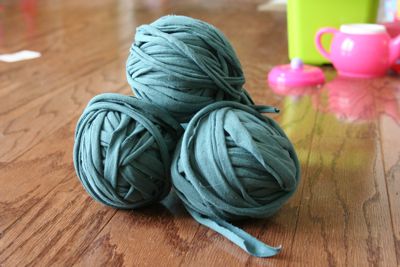
wound yarn

It’s actually not that hard.

First, find yourself some t-shirts. Qualifications: no side seams, minimal decoration. Stitching and ink will keep the jersey from doing the curling trick. You’ll need a ruler, scissors and one of those disappearing ink fabric markers (in a pinch, and if you don’t care about permanence, ball point pen also works).
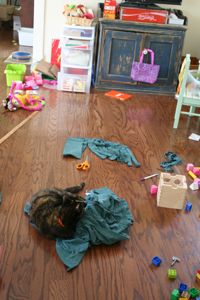
cat in the shirts

Cat is optional.

Cut the bottom of a t-shirt straight across under the arm holes (or under the printing) and slice off the bottom hem. You now have a loop of fabric with two raw edges. (You also have a cropped shirt that would have been awesome in the 80s and a way to restrain prisoners. But for knitting purposes, you only need the loop.)

Flatten the loop into a rectangle as best you can, smoothing out the wrinkles, and arrange it with the raw edges to the left and right. Fold the loop in half so that the bottom edge rests about an inch beneath the top edge.
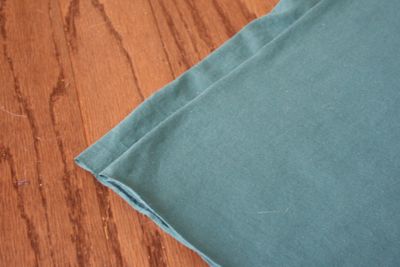
fold over

This is so you don’t have to try and cut straight for two feet.

Now, you don’t have to get out the T-square and go all crazy precise with this next part, just be as neat as you can. Using the ruler and fabric pen, make marks one inch apart along the bottom edge and then along the edge that used to be the bottom edge.
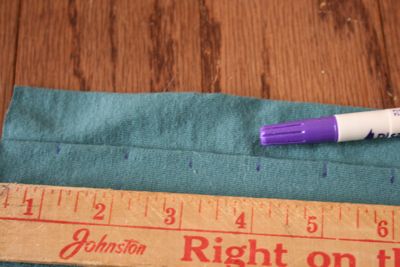
tick marks

Any width is fine, but don’t try smaller than 1/2inch: it breaks.

Get your scissors and cut strips from bottom mark to top mark. Be careful to clip through the marked top edge, but not all the way through the inch of buffer at the top of the fabric. The object is to make one continuous strip of t-shirt – not a bunch of loops.
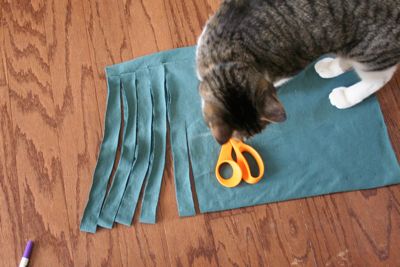
upcyclecut

William Henry, mind your own business!

When you’re finished, it folds out into a hula skirt.
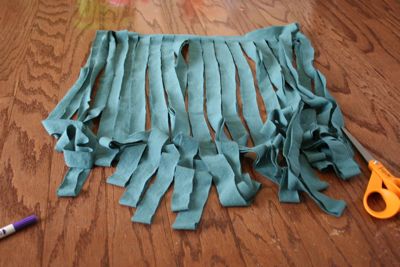
upcyclehula

Which gives me another idea for another time.

Now comes the trickiest part.

Open it all out so that you can isolate the inch margin where the strips are still hooked together. You want to make sure not to cut anything but the margin in this next step. Make diagonal cuts from one strip to the next.
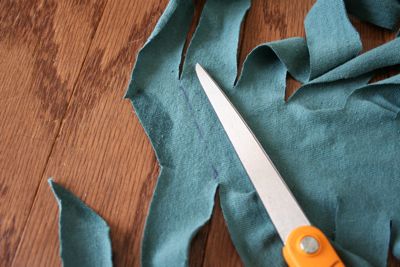
upcyclesnip

Once you get the first one made, the rest are easy.

Then you’ve got a big spaghetti mess that needs to be wound into a ball. As you’re winding, give the strip a nice stretch. It’ll do it’s jersey trick and curl right up.
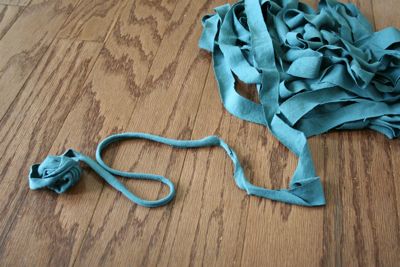
upcyclewind

Jersey is just tiny tiny stockinette after all.

And you’ve got yarn! With 1″ cuts, I got about 26 yards from each large and extra large shirt.

Slice up a pile of white tees and you could make a garter stitch bath mat. Or if you have a bunch of colors, why not try a log cabin rug (Mason Dixon Knitting style). I made a toy, of course.
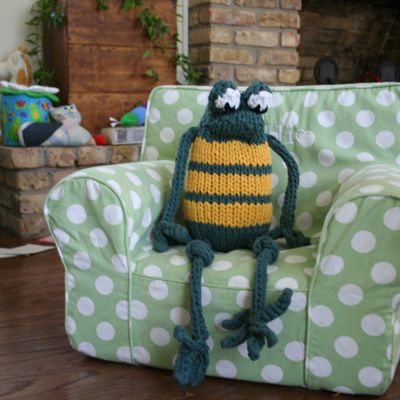
upcyclefrog

I’m a one trick pony these days.

I’ll never knit a t-shirt toy again. Knitting this stuff in a gauge small enough to conceal stuffing was rough on my wrists. This frog is one of a kind.

Next Earth Day, I’ll make a bath mat.
*Note: Cutting t-shirts into yarn isn’t my original idea by any stretch of the imagination. I’m sure there are a ton of tutorials out there much better than mine. If you find yourself saying “Whaaaa?” about my instructions, Google!

Hop

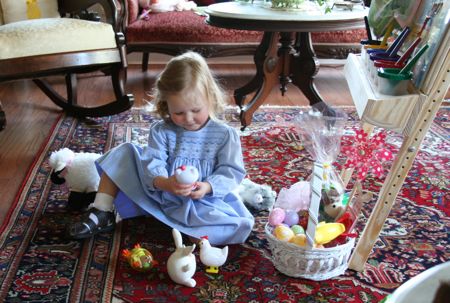
baby basket

Happy Easter!

mouth full

I hope your day was full

chocolate!

of blessings.

The Easter Bunny hides eggs in our yard, but he refuses to come inside (I’m looking at you, William Henry). We go to Great Gran’s to get Ellie’s basket. I’m telling you this lest you think that the beautiful room in the background belongs to me.

Not the Stick

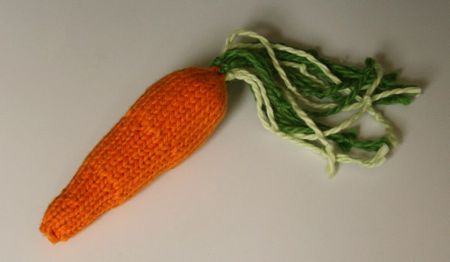
Every Easter basket needs one to keeps the bunnies away from the chocolate. This stuffed carrot is a great last minute project – it’ll take less than an hour.

Carrot
It’s Good for You

carrot

They look exotic with a bunch of different green yarns on top.

Materials: You’ll need about 20 yards of worsted in orange, miscellaneous green yarns for the carrot’s top (I used Blue Sky Alpacas Worsted Cotton), a set of 4 double pointed needles (I used US3s) and something to stuff it and a yarn needle for finishing. A safety pin to use as a marker is also handy.

Gauge: isn’t super important as long as your stuffing doesn’t show. My standard worsted toy gauge is 5sts to 1″ – that will get you a 5.5″ carrot not counting the greens.

Abbreviations: M1 means do that increase where you lift the yarn between the stitches. *blah blah blah* means do the stuff between the *s for the whole round.

Notes: If you don’t like to knit in the round, no problem. Knit it flat in stockinette, seam and stuff before you add the greens. Want a bigger carrot? Double the yarn and increase your needle size accordingly. Try braiding some of the green yarn to make the top more substantial for the big version.

Instructions
Cast on 6 stitches leaving a 4 inch tail.
Arrange stitches evenly on three needles and join to knit in the round.
Round 1: Knit
Round 2: *K1, M1, K1* (9 sts)
Round 3-6: Knit (4 rounds)
Use the cast on tail to close up the bottom of the carrot, securing it to the inside. Mark the beginning of the round with a safety pin if you need to.
I need to.
Round 7: *K1, M1, K2* (12 sts)
Round 8-13: Knit (6 rounds)
Stuff the tip.
Round 14: *K1, M1, K1* (18 sts)
Round 15-24: Knit (10 rounds)
Round 25: *K1, M1, K2* (24 sts)
Round 26-37: Knit (12 rounds)
Round 38: *K1, K2tog, K1*
Round 39: *K1, K2tog*
Round 40: K2tog around
Break yarn leaving about a 6″ tail. Using a yarn needle, pull the cast off tail through the live stitches and remove from the needles. Finish stuffing the carrot, but don’t pull up the opening.
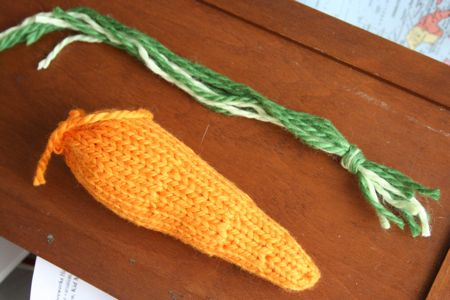
Cut several six inch (at least) pieces of green yarn and tie them all together with an overhand knot at one end.

carrot pieces

Already looks yummy!

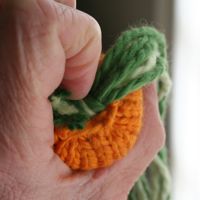
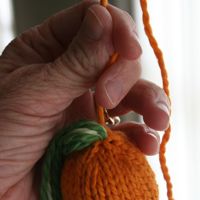
Stuff the knotted end into the open top of the carrot, and draw the stitches up tightly.

stuff in the yarn pull it up

This is the only part that might be considered remotely tricky.

Use a yarn needle to run the tail through the knot several times to hold the green in place and secure the end. Hide the rest of the tail inside the carrot. Trim the green yarn to the desired length. I put knots in my carrot’s greens to give them a nice little flop and to keep them from unraveling. But that’s optional.

Feed to your bunny.

yummy

omnomnom

As always, the things you make from my patterns are yours to give, sell or hoard. But don’t sell my patterns of derivatives of my patterns. That’s just tacky. PDF available on the patterns page. Or just go straight to the pdf.